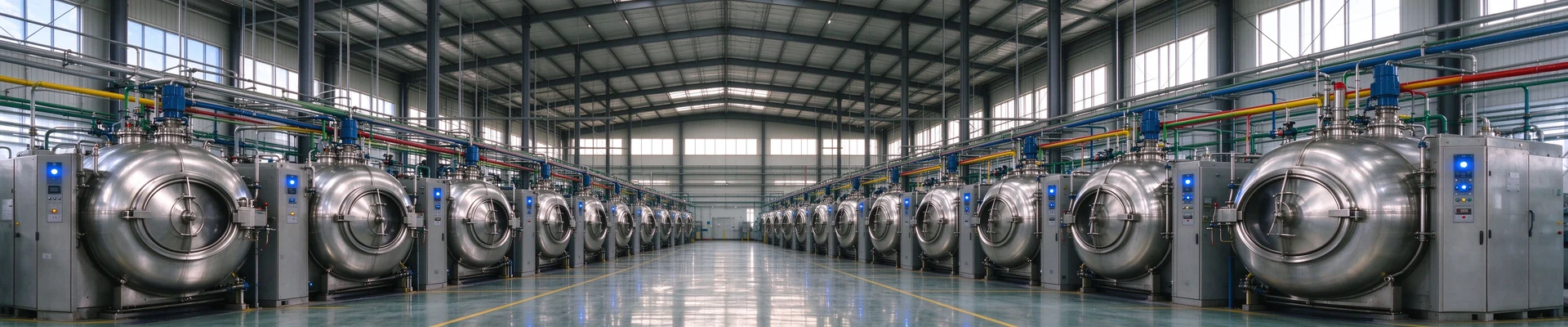
NES-FTS01 Dyeing and Printing Industry 4.0 Unmanned Smart Factory System
From a single dyeing computer to an entire dyeing and printing smart factory, products are organized along four lines: "Control - Management - Delivery - Whole Plant".
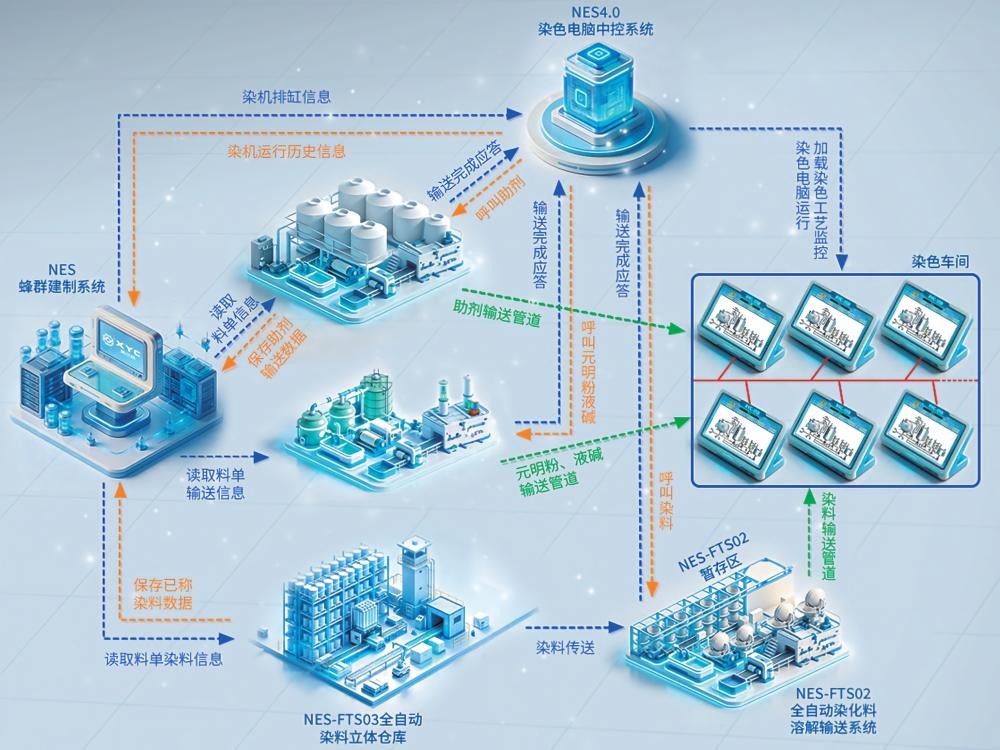
NES-FTS01 Dyeing and Printing Industry 4.0 Unmanned Smart Factory System
The NES-FTS01 system is built on the underlying architecture of the NES series dyeing computers and the NES 4.0 Dyeing Central Control System, and extends into a range of products including the NES additive dosing system, NES dye automated storage warehouse, NES dye and chemical dosing system, and NES Glauber’s salt and caustic soda dosing system, covering key material handling and process control links in dyeing and finishing workshops.
At the software level, the NES Dyeing Central Control System serves as the central command for terminal execution, with all subsystems sharing the underlying architecture of the NES dyeing computers and the central control system. As the number of subsystems increases, the reuse rate of public system resources rises and the share of public resources consumed per subsystem decreases, facilitating future expansion and centralized operation and maintenance.
At the electrical control level, the system retains the core control MPU of the NES dyeing computers and, on this basis, develops dedicated controllers E12 and H12, as well as a high-speed dedicated PLC. These products inherit the ability of NES dyeing computers to operate stably under harsh conditions such as high temperature, humidity, corrosion, and severe electromagnetic interference, making them suitable for long-term use in dyeing and printing production environments.
At the mechanical level, product structural design draws on extensive experience in smart factory mechanical design for the dyeing and printing industry, with emphasis on rational layout, operational reliability, and ease of maintenance.
The entire system achieves full-stack in-house development across mechanical, electrical control, and software domains, reducing technical gaps and integration risks associated with multi-vendor systems. This delivers greater advantages in system stability, service capability, and cost performance, making it well suited for dyeing and printing enterprises pursuing automation, digitalization, and reduced manpower operation.
Product Attributes
Below are the core technical parameters and configuration specifications; please inquire for the complete specification table.

Technical Advantages
The real difficulty in dyeing control does not lie in「Can it be controlled」,but stability, reproducibility and maintainability under long-cycle operation.
Core board, I/O, communication and display are layered and decoupled, so a single-point fault does not spread and spare parts can be replaced without returning the whole machine to the factory.
Using historical batch data to correct heating/cooling and dosing sequences, veteran technicians' experience is distilled into reusable process templates.
300mW Low power consumption reduces temperature rise inside the cabinet, and wide-temperature components suit high-temperature, high-humidity dyeing workshops with minimal long-term drift.
The swarm control operating system makes vats in the same workshop run at a unified rhythm, with centralized recipe distribution reducing lot-to-lot differences and waiting time.
Supports integration with central control, MES and ERP, with automatic upload of production data and no need for manual re-entry.
Once connected, the manufacturer can remotely view operating status and alarm records, so common issues need not wait for an engineer to arrive.
System Architecture
Dyeing computers + central control system + dyestuff and auxiliary delivery + warehousing form the complete closed loop of NES4.0.
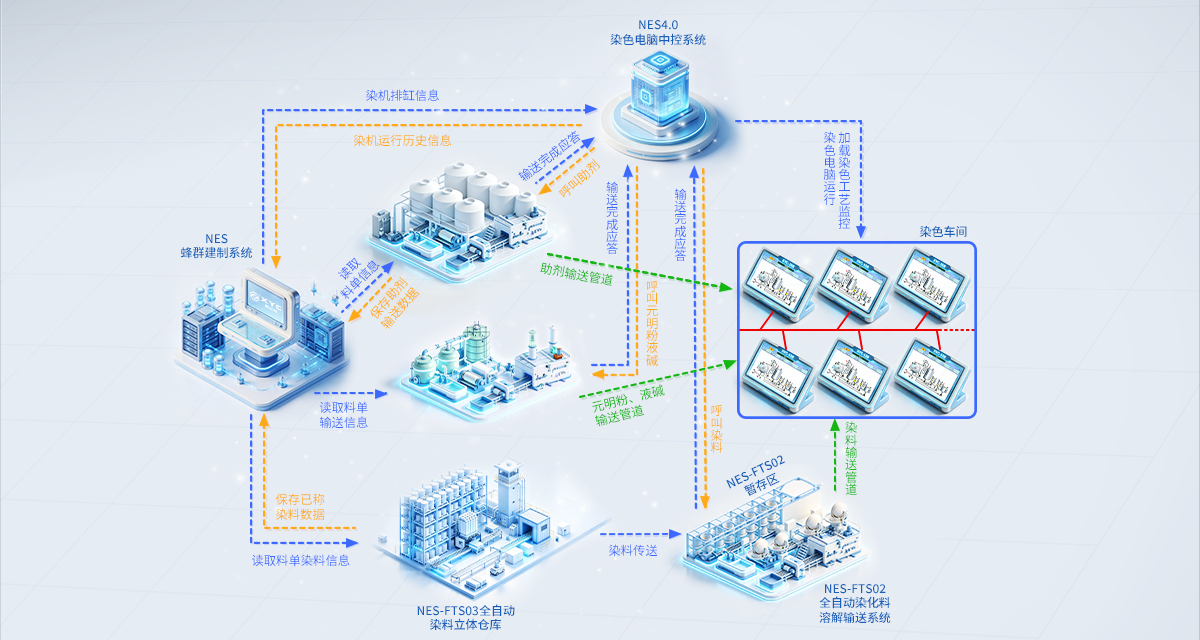
NES-FTS01 Dyeing & Printing Industry 4.0 unmanned smart factory - full-process data closed loop
Need a configuration list tailored to your workshop?
Inform us of the number of dyeing vats, fabric types and current control method, and we will provide a selection table and phased investment recommendations.